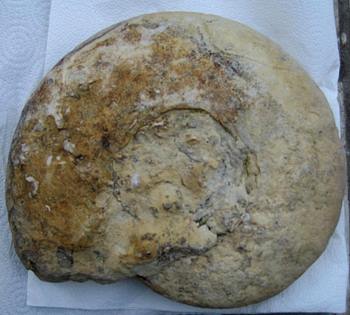
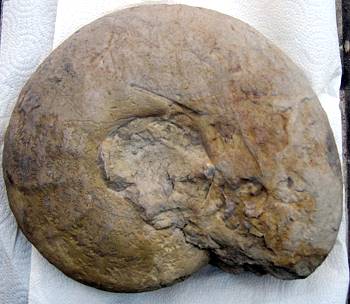
-
It certainly is an ammonite. You can see the typical suture
lines on it. Your mention of an "internal cast" brings
to mind a question I never thought of before. Ammonite fossils are
almost always "solid", that is, the interior of the shell
appears to be completely filled with solid material. However, were
not ammonites compartmentalized internally, just like modern Nautilus
shells? If so, how could sediment get into the innermost compartments
of the shell? ... Paul M.
-
Some field observations.
-
The interior of nautiloid shells fill in by sediment sifting
in through the interior canal that the animal used to balance gas
within its chambers in life. Additionally holes in the shell itself
- such as those created by sulphur sponges are a common pathway
for sediments. As the original shell is often dissolved, evidence
of such perforations are lost.
In my expereince collecting Eocene fossils in NC it is not ucommon
to recover nautilods where the innermost chambers (as well as nuclear
whorls in large gastropods) are not filled in with any sediment,
thus their molds are often missing the upper most chambers or whorls.
In large nautiloids the absence of those preserved chambers may
not be evident as they are obscured by subsequent chambers. There
is often evidence of sulphur sponge borings on the molds of gastrobods
including nautiloids. The challenge is to find that rare fossil
where sediments accumulated all the way to the nuclear whorls before
the shell became buried but before the shell disintegrated as well.
Many ammonites I have seen sectioned are hollow but were filling
in with crystaline minerals at the time they were found.
I think about how much sand one can dump out of long dead helmet
shells found along North Carolina beaches to imagine the process
in action. ...John T.
- Great info John -
Consider trees. They as well as other items left in the land, absorb
dissolved silicon. The
massive amount of silicon in many tropic trees is one concept. This
is what makes crystalline
mud balls that turn into rock with crystals within.
I would think finding a hole in a dead or dying shell depends
on who drilled one (killer shell) and what the shell rubbed against
or what chemical mix it got into.
Might be Calcium Carbonate replacement process as well. Trapped
in a clay layer or under
sand that gets heated by a local up-lift. (Like the now receding
Appalation Mountains as
they aged. In their hay day they were tall. So a lot of local heating
was done.)
I think a chemical process engineer would be handy in the group.
...Martin H.
-
The shape of the suture lines will give you an identification.
I'm not up on the details, but Placenticeras (Cretaceous) might
be worth looking up. They're relatively big and flat. ... Dr. David
C.
-
It’s an internal mold of an ammonite, most likely from
the Cretaceous Period of the Western Interior of the US. I looked
through the Treatise volume and compared it to a similar-sized specimen
on my shelf and it looks very much like Greenhornoceras, a member
of the family Vascoceratidae. The suture pattern, which is used
for ID of ammonite genera, looks to be about the same as that on
my specimen and the published illustrations (at least the same family).
The vascoceratids were basically tropical ammos that migrated north
into the seaway during the Turonian portion of the Late Cretaceous,
and are fairly “common” in the Greenhorn Limestone in
central Colorado. I did my doctorate on such ammos from the Cretaceous
Western Interior in an attempt to show that their shell morphotypes
can be used for environmental interpretations (turned out to be
quite successful – they in general did not drift post-mortem).
Greenhornoceras was one of the most common ones I encountered in
my field work ...- Rick B.
-
Up here in Western New York we have some large Devonian coiled
nautiloids (Nephriticeras magister) that get to be more than 30
cm diameter, and in several specimens I've encountered the innermost
whorls are not well preserved if at all. Often the inner ones when
they are preserved are geodized - crystals growing inward from the
chamber walls but still leaving an open cavity. Makes it really
hard to work out a good specimen from the concretion they are found
in. In the Cretaceous ammonites I've worked with it seems either
the siphuncle or breaks (from borers, etc) must have provided conduits
for fine sediments to enter the shell - especially in the finer
deposits of chalky sediments - and even then the smallest innermost
whorls may be absent.
As for the ammonite specimen, probably not a placenticeratid - sutures
are way too simple and the sutural amplitude index (ratio of suture
pattern height to length, a measure of how deep the critters could
live) is way too small in placenticeratids compared to this specimen.
Placenticeras stuck to shallow bottom areas (usually close to shore)
- the complex sutures of that ammo were not related to depth but
rather to prevent the shell from breaking too much should a mosasaur
decide it wanted some calamari for dinner but not quite succeed.
...- Rick B.
- It could be a middle Triassic Flemingitidae, going by whorl-profile,
ribbing and sutures, but I can't see the sutures quite well enough
(a clear closeup image of a good section of suture would've been useful).
Beyrichitidae is a related family also possible. But it could also
be a Jurassic or Cretaceous beast. It certainly is not Placenticeras.
It certainly is an ammonite. You can see the typical suture
lines on it. Your mention of an "internal cast" brings
to mind a question I never thought of before. Ammonite fossils are
almost always "solid", that is, the interior of the shell
appears to be completely filled with solid material. However, were
not ammonites compartmentalized internally, just like modern Nautilus
shells? If so, how could sediment get into the innermost compartments
of the shell?
When an ammonoid is buried and sedimentation continues, pressure
due to the column of new rock above results in pressure being applied
to the specimen. It's remarkable how this can inject sediment grains
through the tiny siphuncular openings in the septa (these are ventral
in Triassic & later ammonoids ie they are at the "outer
edges" of the whorls). Also, being thinwalled, the siphuncles
and even septal walls are prone to rupturing under pressure, especially
ammonoids with their very thin septal walls. I have sectioned intact
Triassic nautiloids (Proclydonautilus) to find loose and broken
septa well within.
The interior of nautiloid shells fill in by sediment sifting
in through the interior canal that the animal used to balance gas
within its chambers in life. Additionally holes in the shell itself
- such as those created by sulphur sponges are a common pathway
for sediments. As the original shell is often dissolved, evidence
of such perforations are lost.
It is doubtful that borings etc pierce the shells to allow sediment
to enter; dredgings of long-dead shells from the continental shelves
show that most shells are unbored even after lying on the seafloor
for as long as much as a million years; if a steinkern resulted
from such a shell, the boring (or hole broken into the shell wall)
would result in a matrix continuation from surrounding rock to steinkern,
and I have never seen an ammonoid or nautiloid with such a a clearly-defined
boring. Ammonoids were also much more thinwalled than nautiloids,
and so made a poor substrate for borers.
In my expereince collecting Eocene fossils in NC it is not ucommon
to recover nautilods where the innermost chambers (as well as nuclear
whorls in large gastropods) are not filled in with any sediment,
thus their molds are often missing the upper most chambers or whorls.
In large nautiloids the absence of those preserved chambers may
not be evident as they are obscured by subsequent chambers. There
is often evidence of sulphur sponge borings on the molds of gastrobods
including nautiloids. The challenge is to find that rare fossil
where sediments accumulated all the way to the nuclear whorls before
the shell became buried but before the shell disintegrated as well.
I have collected Eocene nautiloids (Aturia, Hercoglossa) locally
in a horrid slimy muddy siltstone which was not injected into the
inner whorls. nautiloids are present in the hundreds, up to about
30cm diameter or a bit more. The shell is preserved and still nacreous
and no borings are present. The unfilled chambers have collapsed
under sedimentary compaction, resulting in difficult-to-prepare
(and collect!) rather unesthetic specimens. The collapse was not
plastic (distiorsion) but resulted in shattering of the shell material.
Note that ammonoids evolved from nautiloids, but that they became
very different. The shells remained similar in may ways, but it
seems that ammonoid animals were much more coeloid (squidlike).
...Andrew G.