|
Data:
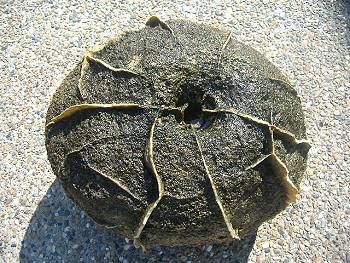
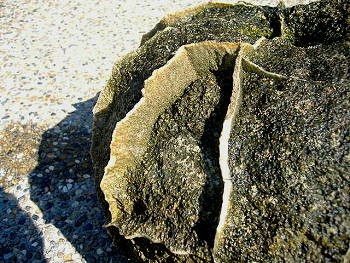
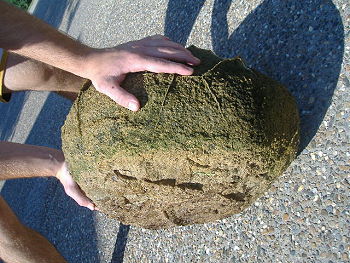
Here are some pictures
of a fossil from our farm in Kansas that I have not been able to identify.
The farm has a shale bed which has produced shark's teeth, vertebrae,
and tons of other identifiable fossils. This one is a mystery.
Thanks for your help.
Email 2: Hey Avril,
I think we need to add some additional information about this "rock".
It is definitely not made up of any limestone. We made fence posts out
of limestone all over that farm and I know what it looks and feels like.
Also, the "fins" are ALL made of two, flat quartz like looking
plates, fused together, thru out the sphere. The rock portion or "fill"
looks more like rough concrete, and my weight lifting sons guestimate
it to weigh around 300 lbs.
Send
Ideas to: Mike
|
|
Identified:
Discussions:
-
The Kansas sphere
is a ‘septarian nodule’. These concretions form in the
shale, often around a rotting organism that was quickly buried.
The rotting forms a change in the local water chemistry, precipitating
calcite (or siderite) in the mud around the material. At a later
time the concretion split open in different directions and these
were filled with calcite crystals. There may be a recognizable fossil
in the concretion, but the secondary cracks would mess it up. Similar
ones in Utah are sometimes cut and polished as decorative stone.
... Allen A.
- The thing from Kansas isn't a fossil. It's actually an example of
differential erosion: a long time ago, this rock had fractures. These
fractures were filled up by a mineral that is more resistant to erosion
than the surrounding rock. The rock weathers away faster than the
mineral, creating these projecting "blades".
If I had to guess, I'd say the rock is limestone, and the "blades"
are calcite.
Cheers, James C.
|